
Embodied Wisdom: Indian Knowledge Systems and Traditional Performing Arts
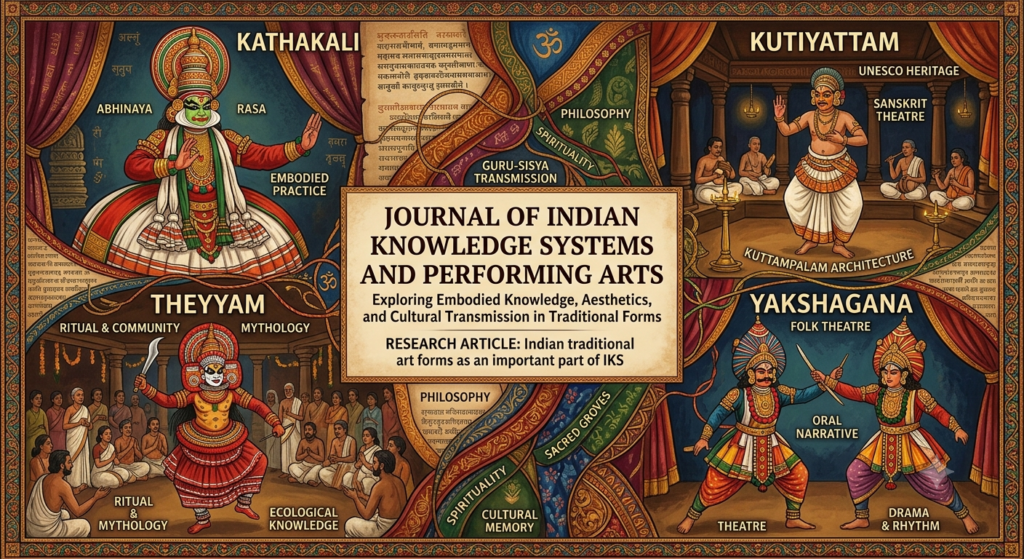
Dr.V.AshaKumari Head & Research Supervisor Centre for Post Graduate Studies and Research in English, Muslim Arts College,Thiruvithancode. (Affiliated to ManonmaniamSundaranarUniversity,Tirunelveli) Abstract Indian traditional art forms are an important part of Indian Knowledge System (IKS) because it preserves Indian traditional knowledge of philosophy, spirituality, the human body, nature, community, ethics and modes of learning. Along with acting as a mode of entertainment, traditional art forms of India transmit knowledge through embodied practice, oral narrative traditions, ritual performances, symbolism, music, gesture, costumes and audience experience. When it comes to IKS, that is, the Indian knowledge systems, its traces can be found in a variety of art forms in India. Whether it is the long-standing classical arts or the Performing Arts that require stage presentation, all contain traces left by this system.The art forms of Southern India like Kathakali, Kutiyattam, Theyyam, Yakshagana, and several folk, ritual performances carry the Indian Knowledge Systems that have been passed down from generations back. The contemporary Indian Knowledge Systems initiatives recognize performing arts as an important area of knowledge that encourages interdisciplinary research in these traditions. This research article examines the conceptual relationship between IKS and Indian traditional performing art forms which focuses primarily on embodied knowledge, aesthetics. The core directions covered in this research include guru-sisya transmissions, spirituality, ecology, community memory. Keywords: Indian Knowledge System (IKS), Indian traditional knowledge, Kathakali, Kutiyattam, Theyyam, Yakshagana. Introduction Indian Knowledge system (IKS) refers to the interconnected diverse knowledge developed in the Indian subcontinent. It developed through centuries of intellectual, cultural, oral traditions that existed in the subcontinent. The origins and development of the contexts in centuries-old Indian Knowledge in the fields of philosophy, literature, linguistics, astronomy, medicine, mathematics, agriculture, ecology, music, dance, theatre, visual arts and spirituality can all be found in this system. These contents, passed down from ancient times, have always been bound to this system and inherited together to this day. In addition to literary intellectual texts, Indian Knowledge System includes living traditions preserved through communities, oral transmissions, and every day practices. Performing arts and fine arts can be included in the areas of IKS. Traditional performances evolved out of literature, music, philosophy, rituals, psychology, and discipline of the body, and community knowledge integrates Indian knowledge, experience, practice and cultural memory, growing from the land of India. IKS usually enquires into the interconnectedness between human beings, society, nature and the cosmos, which is acquired through practice and experience instead of theoretical study. Since many traditions have been passed down orally – through stories, songs – and oral instruction, many existing studies have focused on the Indian guru-sisya tradition, all centering on the same core question: how this ancient master-apprentice inheritance model directly transfers knowledge from teacher to student, exploring what role this tradition plays in the entire process of knowledge inheritance. Its focus on traditional community-based knowledge attaches importance to knowledge transmitted through communities, families, practitioners and indigenous groups. IKS, this Indian knowledge system, breaks away from the modern academic knowledge framework we are familiar with, offering another way of thinking that helps us re-understand what knowledge, culture, nature and society are, and how they influence each other. It is relevant as an interdisciplinary way of understanding the contemporary world. It gives scholars a chance to investigate Indian intellectual and cultural traditions that go beyond the long-standing inherent assumption that knowledge only exists in the theory-centric modern academic system, with the boundaries of knowledge defined within this system, and nothing outside it counts as real knowledge. Interconnectedness between IKS and Indian Traditional Art Forms The contemporary Indian Knowledge Systems framework recognizes “Performing Arts” as an important area of research within Indian knowledge traditions (Indian Knowledge Systems Division). Present IKS framework scope ranges across wide areas including historical and civilization studies, speech and linguistics, mathematical and astronomical sciences, health sciences, agriculture, performing arts, architecture, fine arts and sculpture, and other fields. This interdisciplinary character can also be applied to Indian traditional art forms. For example, an Indian classical dancer must have the knowledge of rhythm, music, gesture, mythology, literature, mudras, costumes and narrative traditions connected to the performance. Thus, these traditional art forms are not paper-based knowledge floating in books, but a kind of “living knowledge”. It cannot be learned by sitting in classrooms reading lecture notes and taking exams. To truly grasp this knowledge and engrave it into one’s bones, several things must be achieved: one must practice hard day after day in accordance with the rules, without slacking or interrupting; one must observe carefully following the examples of predecessors, taking in all the details; one must proactively imitate and polish every link, not altering it arbitrarily; one must memorize all the contents carefully, without ambiguity or omission; one must fully devote oneself to every step of the art inheritance process; and finally, one must continue to perform on stage, activating and passing on the knowledge in real presentations. Bharata Muni’s Natyasastra, the text traditionally associated with dramaturgy and performance, is one of the important foundations for understanding the relationship between IKS and traditional performing arts. Its scope extends across multiple dimensions of artistic knowledge. The book explains how an artistic performance becomes systematic knowledge by discussing dramatic composition, acting, gesture, movement, music, dance, stage design, costume and makeup, emotional states, aesthetic experience and performance conventions. In a stage performance, content is not only conveyed through the lines spoken, but also through abhinaya – that is, bodily performance. It is not only about telling the story to the audience through speech; the performers’ bodily movements, expressions and gestures, these physical expressions, are also core parts of conveying information in the performance. They must cooperate with language to fully present the intended content. This integrated understanding of gestures, facial expressions, costumes and external representations, the concept derived from this ancient text, has been passed down to this day and still promotes the development of Indian performing arts. The rasa theory proposed in this text requires performers to not only replicate movements in the performance, but to master
