
Impact of Climate Change on Human Wildlife Conflict and Social Implications
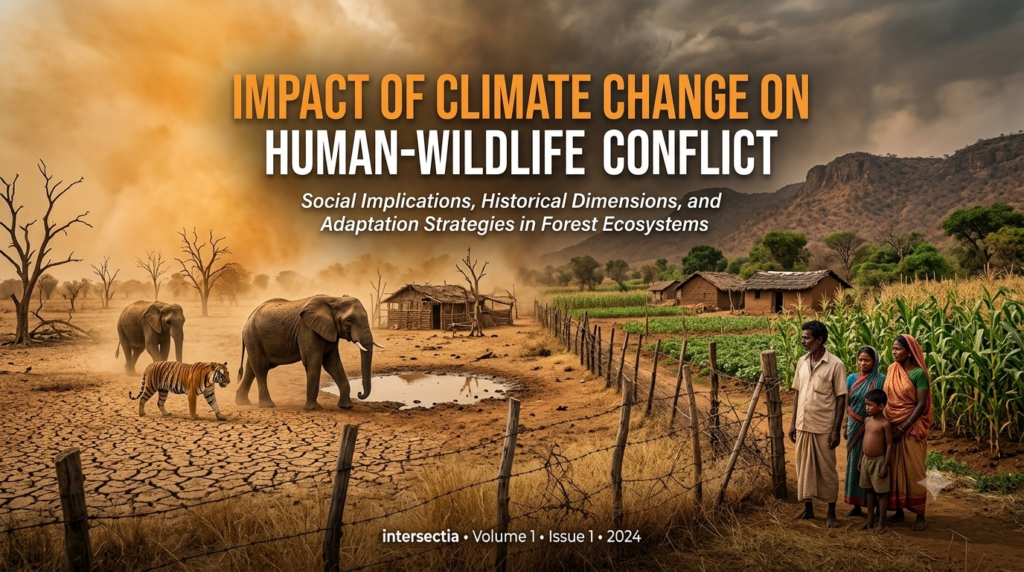
Abstract Paper reviews the extent of climate change on forest ecosystems and that impact the Human Wildlife Conflict (HWC). Historical dimension of HWC, implication of HWC on society, and social dimensions of HWC are all part of discussion in the paper. Human perceptions on wildlife are influenced by socio-cultural factors and also their influence on public policy. Paper concludes that interventions to reduce HWC are designed to reduce the frequency of interaction between people and wild animals along with initiatives to enhance the tolerance of societies in conflict situations. Key words: Human-Wildlife Conflict (HWC), Climate change, Forest management, Implications of HWC, Social dimensions Introduction Human Wildlife Conflict (HWC) is described as conflict between humans and wildlife wherein the actions of latter affect the former and vice-versa. Threats to human life, economic loss, food security, etc. are some of the major impacts of HWC (Redpath, SM, et.ail., 2013). HWC is predicted to intensify in response to global environmental issues such as climate change and the destruction of wildlife habitats and forests (Mason et al., 2018). HWC fosters widespread environmental, social, economic, and political problems across the globe (Guerra, 2019). Human-Wildlife Conflict (HWC) management is a multi-disciplinary concept involving animal behaviour, conservation biology, ecology, genetics, wildlife ecology, zoology, anthropology, economics, environmental studies, geography, history, natural resources management, political science, psychology, technology and so on (Nair, 2009). In the last two decades HWC management has attracted increased attention due to growing recognition that HWC affect societies globally and hinder conservation efforts along with the attainment of goals of sustainable development. Major objective of the paper is to review the gravity of climate change on HWC and implications of the HWC on society. Paper also discusses the impact of climate change on forest ecosystems and biodiversity, leading to species extinction. Historical dimension of HWC and implication of HWC including costs and gender dimension are also discussed in detail in the paper. Review of social dimensions of HWC with emphasis on cultural diversity is also part of the paper. Climate change as drivers Deforestation and climate change are reciprocally related; temperature, radiation, rainfall and carbon dioxide in the atmosphere are the backbone of forest dynamics, whereas forests in turn will influence climate by seizing atmospheric carbon, solar radiation, cooling atmosphere through evapotranspiration and even producing cloud-forming aerosols. Figure-1 depicts the relationship between forest and climate change. Climate change is anticipated to have significant impacts on forest ecosystems and accordingly forest management should adapt to changing scenarios. Impact of climate change on forest ranged from large-scale biome shifts to relatively less extensive disruptions in forest growth (Aber, et al. 2001). The increasing temperature and droughts will have negative impact on species diversity as well as ecosystem goods and services to humanity (Gnacadja and Lesch 2009). Major drivers of climate change includes anthropogenic causes such as land use changes, deforestation and forest degradation, fossil fuel burning and industrial processes and natural causes such as solar radiation changes and volcanic activity. Deforestation and forest degradation play a critical role in global climate change, and reciprocally, deforestation is indirectly affected by climate change too. In the past, nearly 45% of the land surface was covered by forest, which dwindled to nearly 30% due to shifting cultivation and other human activities. FAO reports show that current deforestation rate is 0.14%, which is 5.2 million hectares per annum (FAO, 2012). Greenhouse gas (GHG) emissions from deforestation and forest degradation are reported to account for about one-fifth of the total GHG emissions. Figure: 1 Inter-relationship between Forest and Climate Change Deforestation $\longleftrightarrow$ Climate Change $\longrightarrow$ Carbon Sequestration $\longrightarrow$ Impact on Forest $\longrightarrow$ Deforestation Source: Khaine, Inkyin & Su Young Woo (2015) Forest growth rate is reported to be correlated with climate, especially the water availability (Toledo et al. 2011). Increasing temperature and precipitation will directly influence tree growth, whereas increases in dry period will have a negative impact on growth of forest. Even the solar radiation has an impact on forest growth. The role of forests in environmental management is very important and it ranges from carbon sequestration to water and soil conservation. Carbon storage capacity of forest is significantly affected by environmental conservation. The global forests store over 650 billion tons of carbon in various forms including 44% as biomass, 45% in the soil and 11% in dead wood and litter (FAO 2010). Recent researches shows gloomy picture for the future of forests and due to global warming, carbon regulation services of forests will be lost, as land ecosystems may turn into a net source of carbon dioxide by end of the century (Seppala et al. 2009). Studies also indicate that climate change will have moderate to large-scale impact on forest through shift in vegetation and biodiversity. Studies conducted in India demonstrate that nearly 39% of forested grids are vulnerable to climate change (Chaturvedi, et. al, 2011). The climate impact assessment studies done on Indian forests show that nearly 68% to 77% of the forested grids are likely to experience changes including loss of area under current forest type as well as replacement by a different type by 2085 (Ravindranath, et. al., 2010). Climate change may damage unique forest ecosystems and biodiversity, leading to species extinction. Sustainable forest management as a tool to climate change adaptation management has provided positive results across the world. Sustainable forest management measures helps to ensure that adaptation and mitigation measures are carried out by accounting the economic, social and environmental value of forests (Nair, 2010). Adoption of landscape approach will help in implementing forest-based climate change adaptation and mitigation measures that lead to optimal economic, social and environmental outcomes. Adaptation to climate changes includes adjustments in ecological, social, and economic systems in response to the effects of changes in climate (Smit et al. 2000). Adaptation to climate change in forest management requires a planned response well in advance. Adaptation requires setting up of objectives for the future forest under changed scenario, increased awareness and education, determining the vulnerability of forest ecosystems and society, development
