
Prompt Writing as a New Form of English Composition: Rethinking Creativity, Authorship and Pedagogy in the Age of Generative AI
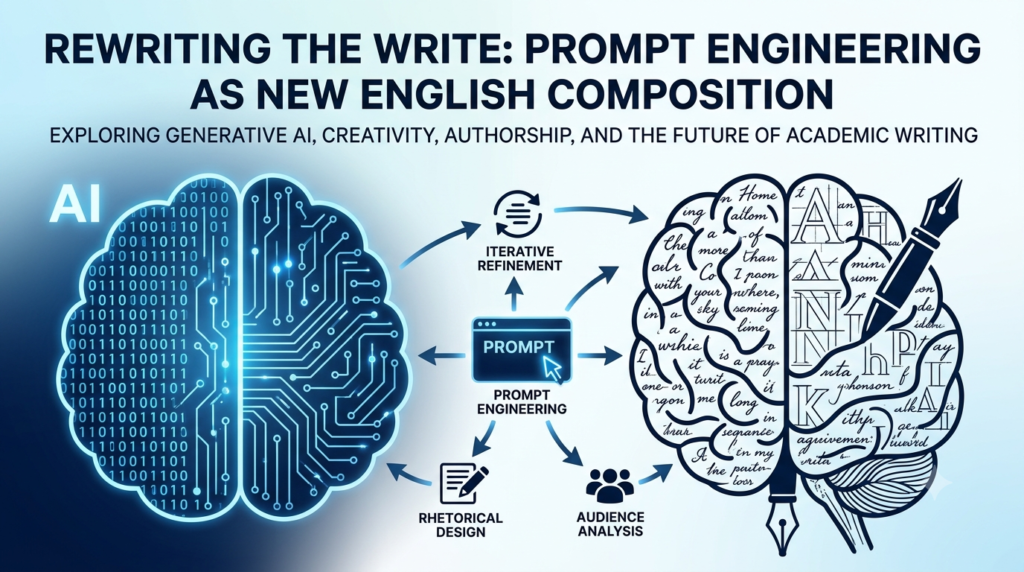
Research Guide Dr. Amit Kumar Dwivedi Professor, Department of English University of Technology Jaipur, Rajasthan, India Abstract Following the rise of Generative AI (GenAI), writing models in higher education have been completely transformed. In the past, most English writing required students to independently complete full essays on their own. Today, the landscape has changed: students must first draft clear instructions for AI in natural language, specifying what content they want to generate and what requirements it must meet—these are the so-called prompts. This task is no longer a minor affair that can be handled by typing a few lines; it has emerged as a new form in the field of English writing. This paper argues that crafting effective prompts is itself an independent act of writing. Long-held assumptions about creativity, authorship, and writing pedagogy must be re-examined in light of this development. Previously, it was universally accepted that writing an essay was a creative task that a single person could complete, that creativity was an exclusive, sudden spark of inspiration unique to the author, that authorship belonged solely to the individual who produced the final work, and that the goals of writing instruction were structured around solo creation. However, the new model of collaborative writing between humans and AI has upended all these unspoken rules. Drawing on the latest academic achievements in writing studies, educational technology, and critical AI research, this paper breaks down the core competencies required for prompt engineering: solid rhetorical skills, the ability to repeatedly refine and adjust work, and proficiency in critical evaluation. Prompt engineering, defined here as the process of iteratively optimizing input instructions for AI until the required output is achieved, demands the same careful consideration of audience, purpose, and context as traditional writing. It requires precise wording, repeated revisions of vague or error-prone sections of instructions, and the ability to judge whether AI-generated content is high-quality and meets requirements—none of which are skills that can be learned casually. This paper discusses the impacts on the concept of “authorship” that arise when responsibility is distributed between humans and non-human entities like AI, and it presents an institutional framework for integrating prompt literacy into English writing courses. Since the completion of an essay now involves both human effort in writing instructions, selecting content, and revising work, and AI participation in generating first drafts, authorship can no longer be attributed to a single individual, and its boundaries must be redefined. To enable all students to master this skill, the ability to write effective prompts and use AI appropriately must be formally incorporated into college English writing courses, and this paper puts forward specific ideas for constructing such instruction. Finally, this paper puts forward recommendations across three areas: assessment design, academic integrity policies, and faculty capacity development, to help all stakeholders establish responsible, AI-integrated writing models. It aims to enable teachers, students, and institutions to keep pace with this new era of writing, embrace the conveniences brought by AI while upholding the bottom line of academic creation, and ensure that AI truly serves as a tool to assist writing rather than a threat that disrupts teaching order. Keywords: prompt engineering, generative AI, English composition, authorship, creativity, pedagogy, AI literacy Introduction Generative AI (GenAI) tools such as ChatGPT, Claude, and Gemini have rapidly integrated into the entire workflow of academic writing, completely rewriting students’ and teachers’ understanding of writing and transforming how everyone approaches the act of composition (Bannister et al., 2025; Carbonel et al., 2025). These AI systems can interpret ordinary user instructions and generate increasingly sophisticated and coherent texts in response, and they are used by people across all levels: students writing papers and teachers grading assignments all rely on these tools to handle text-based work. In this context, the practice of refining writing prompts—repeatedly deliberating over and polishing input texts that can accurately guide AI to produce content meeting specified requirements—has emerged as a core academic literacy skill (Crosthwaite et al., 2025; Knoth et al., 2024; Walter, 2024). Simply typing a line like “write a paper for me” will never yield usable content; demands must be broken down and clarified, boundaries clearly defined, before AI can output content that aligns with a user’s needs. This skill of refining instructions has become a hard technical competency required for all academic work, not just for AI specialists. This paper proposes that writing prompts is itself a brand-new form of English composition, and the entire existing framework for creativity, authorship, and pedagogy must be adjusted accordingly. The significance of this shift extends far beyond mastering a technical skill. To execute prompt engineering well—that is, to refine AI instructions to a functional standard—writers must first articulate their goals clearly. They cannot vaguely request “a good essay”; they must specify whether they are writing a course paper or a conference submission. They must also set appropriate contextual boundaries for the content: whether it must meet undergraduate writing requirements or align with the academic standards of a top-tier conference. Most importantly, they must anticipate potential ambiguities, for example, preventing AI from misinterpreting a request for “carbon neutrality in environmental science” as general popular science. Finally, they must repeatedly polish their wording until AI can accurately grasp all requirements, to produce the desired outcome (Park & Choo, 2024; Cain, 2024). These steps closely align with the core competencies of audience analysis, rhetorical planning, and iterative revision in traditional writing. When composing a traditional essay, writers also clarify who their audience is, what goals they aim to achieve, and repeatedly revise and refine their drafts; the underlying logic is consistent. However, this process is carried out within a human-AI collaborative system, directly overturning the traditional model of authorship. Where it was once assumed that an essay was written entirely by one person from start to finish, this old narrative no longer holds when humans and AI collaborate to create content (Rancière, 2024; Cuenca et al., 2025). As mainstream scholars have observed, Generative AI has not only changed how writing is produced, but
