
Colonial Impacts on Visual Culture: An Aesthetical Reading on the Selected Paintings of Raja Ravi Varma
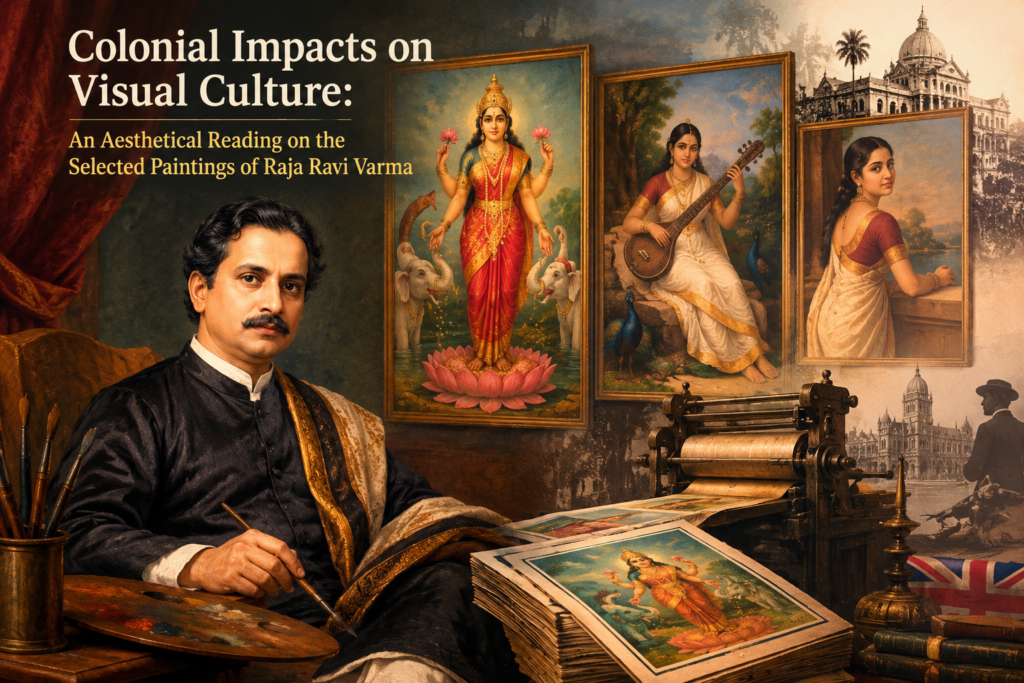
Raja Ravi Varma was an Indian artist from the princely state of Travancore, Kerala. Ravi Varma achieved recognition for his depiction of scenes from the epics of the Mahabharata and Ramayana. The work of Raja Ravi Varma is considered among the best examples of the fusion of Indian traditions with the techniques of European academic art in the colonial nineteenth century. Varma became the best-known allegorist of Indian subjects through his depiction of scenes from the epics of the Mahabharata and Ramayana. Ravi Varma considered his work as “establishing a new civilizational identity within the terms of 19th century India”. He aimed to form an Indian canon of art in the manner of those of classical Greek and Roman civilizations. Varma’s art came to play an important role in the development of Indian national consciousness. Varma purchased a printing press that produced oleograph copies of his paintings, which graced middle-class homes in India for many decades after his death. Considered a genius in his heyday, Varma’s paintings came under severe criticism for mimicking Western art within a few years of his passing. During the colonial era, Western influences began to make an impact on Indian art. Some artists developed a style that used Western ideas of composition, perspective and realism to illustrate Indian themes, with Ravi Varma being prominent among them. The Bengal School arose as an avant-garde and nationalist movement reacting against the academic art styles previously promoted in India, both by Indian artists such as Varma and by British art schools. The Ravi Varma Fine Arts Lithographic Press, which started production on the outskirts of Bombay in 1894, and the Calcutta Art Studio spread a specifically Hindu visual representation of national identity. Without the large-scale reproduction of images configured and typified by Varma in European neoclassical and academic styles, a refutation of this aesthetic by the Bengali neotraditionalists would not have been possible. These commercial precursors contributed to the Bengali neotraditionalist, quasi-avant-garde movement that sought to reconfigure Indian aesthetic modernity using pan-Asian aesthetics. Oleography refers to a method of reproducing an oil painting in such a manner that the exact colours and brushstroke textures are reproduced using lithographic stones corresponding to the colours and tones in a painting. Oleography was a comparatively new form of printing at the time, mastered by an Englishman named George Baxter in 1835. It came into commercial use by 1860 but had already become an exhausted force by the end of the century in Europe. The idea of printing and distributing oleographs was given to Ravi Varma by Sir T. Madhava Rao, former Dewan of Travancore and later of Baroda. In India, before Ravi Varma’s prints, oleography was used for gaudy “calendar art” and commodity packaging. “Oleo” is the Latin word for oil, which helps explain the term. The period of production of Ravi Varma’s oleographs coincided with the rise of Calcutta as a rapidly expanding urban centre, both politically and culturally. The oleographs of Lakshmi and Saraswati were produced at a time of intense nationalist fervour. The two goddesses, Lakshmi and Saraswati, painted around 1896, are iconic in their visualisation. The religious texts and oral traditions that formed the basis for these paintings do not belong to any particular region of India, as the entire country has always absorbed these goddesses into its cultural life. Despite such identification, Ravi Varma could not have realised the extent to which his two images, given new meaning through the medium of oil paint, would endear themselves to the people of India. Like other artists and writers, Ravi Varma presented his goddesses in his own manner and with a specific intention in mind. He sought to convey their pan-national identity at a time when foreign rule was being questioned and dreams of a free nation were being voiced. The images they conveyed were of great importance, and he therefore wished to project them in clothing appropriate to that identity. Given the choice of portraying Lakshmi either seated or standing, he preferred to portray her standing on a lotus pedestal, rising above the elephants. It was an inspired choice. She clearly displayed a saree worn in a style rarely seen before. Her saree did not belong to any particular region, nor was it associated exclusively with any special group of people. This style transcended regional borders within the country, subsuming cultural differences at a time when India was seeking its national identity. It was a powerful message, replete with patriotic significance. The combined use of Hindu sacraments and the celebration of woman as “Shakti” created an externalised image of the female as a Devi, which was read, viewed and understood as a site of power to be used against the British. Varma used the concept of the mother and transposed these signs onto a woman. His Durga, as well as indigenous forms such as the Kalighat Kali, helped create a supposed secular image of the nation. The European quest for “realism” in painting also manifested itself in colonial India. The method of oil painting and the various techniques employed—such as perspective, chiaroscuro, three-dimensionality and tactile illusionism—gradually witnessed a synthesis with India’s traditional art forms, which heavily relied on classical and religious themes. The fusion of Western techniques with India’s traditional painting led to the creation of a new genre that later became an exemplar of a “new model of art”. The pictorial model popularised by the Calcutta Art Studio, with its interplay of the “realistic” and the “mythic”, and of “high art” and popular iconography, received a new boost through the Puranic paintings of Raja Ravi Varma. His self-education in European art techniques, academic oil painting and mastery of realistic portraiture made him the epitome of evolving “modern” art in India. However, it is noteworthy that his Western education ran parallel to indigenous and traditional influences. The interaction between the traditional and the modern, evident in Ravi Varma’s education, found expression in his paintings as well, eventually leading to the creation of an altogether new genre