
Generative AI and Social Intelligence: Technology and Humanity
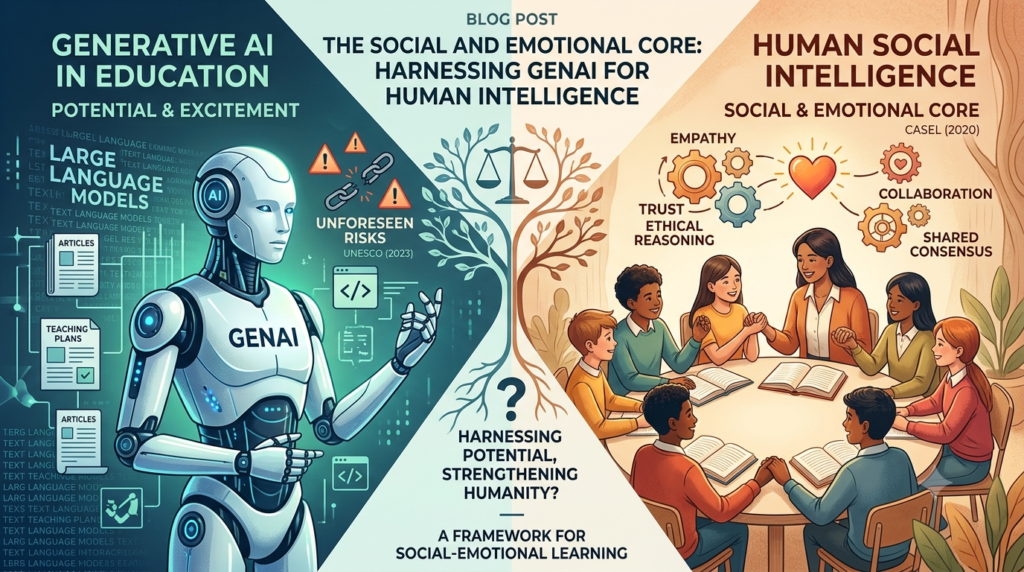
Dr Amit Kumar Dwivedi Research Supervisor University of Technology Jaipur Abstract Generative artificial intelligence (GenAI) is reshaping the landscape of teaching, learning, and assessment. Its rapid expansion in educational settings has brought forth a set of pressing issues: what will become of social intelligence in education moving forward? This paper untangles a core set of tensions: the high efficiency of GenAI clashes with the unique, irreplaceable human capacities of empathy, moral judgment, and relational learning. These capacities are the foundation for building genuine connections between people and achieving deep, meaningful growth in educational contexts—no technological tool can replace their role. GenAI can help people quickly organize materials, generate first drafts, and handle cumbersome administrative tasks; these efficiency gains are tangible. But if it is allowed to seep unbound into the core processes of education, these uniquely human core capacities will lose the space to develop. This is precisely why this paper confronts this set of tensions head-on. Drawing on UNESCO’s human-centered AI guiding principles, trustworthy AI frameworks, and the latest research in the field of social-emotional learning (SEL), this paper argues that the use of GenAI must be constrained by educational and ethical principles to safeguard human autonomy and enable genuine human-AI collaboration. All of these referenced standards and studies point to a single core: technology must not lead education; AI must always serve human growth itself. Only by upholding this baseline can human-AI collaboration avoid devolving into human replacement by AI. This paper also proposes a theoretical framework to cultivate human social intelligence sustainably while leveraging technological advantages. This framework prioritizes Critical AI Literacy and Ethical Awareness, Dialogic Pedagogy, and Institutional Safeguards. To balance the conveniences brought by technology and the cultivation of core human capacities, we cannot stop at vague advocacy; we must implement concrete actionable pathways: first, ensure all teachers and students can understand AI and recognize its limitations; second, deploy AI through teaching methods that stimulate deep dialogue between people; and finally, rely on rules from schools and the entire education system to prevent misuse of technology from eroding the humanistic core of education. At the end of the paper, recommendations are put forward for policy development, frontline practice, and future research directions respectively, to ensure that GenAI can ultimately serve an educational future that is more inclusive, equitable, and always preserves its humanistic core. Keywords: generative AI, social intelligence, social-emotional learning, human-centred AI, education ethics Generative AI and Social Intelligence: Balancing Technology and Humanity As generative artificial intelligence (GenAI) rises in the education sector, the field’s reactions have split in two: on one side is excitement over its potential to drive new transformations, and on the other is anxiety over its unforeseen risks. Common generative AI tools such as large language models (LLMs) can draft articles for users, generate complete teaching plans, and simulate one-on-one tutoring conversations. According to UNESCO (2023), these capabilities hold the promise of delivering unprecedented personalized teaching outcomes and elevating the efficiency of the entire education chain to new heights (UNESCO, 2023). Yet it is precisely these seemingly highly practical capabilities that are gradually undermining the foundational bedrock that makes learning possible: the social and emotional core that enables people to learn together—empathy, trust, ethical reasoning to distinguish right from wrong, and the collaborative ability for groups to sort through ambiguous problems and build shared consensus. These capacities are not cold technical metrics; they are the core of education as a warm, shared enterprise for all humanity. Holmes (2023) and Miao & Holmes (2023) both highlighted this core, which is threatened by technology (Holmes, 2023; Miao & Holmes, 2023). The core question this paper seeks to answer is clear: how can the current education system harness the potential of generative AI, while not only retaining but further strengthening the uniquely human social intelligence? Centered on this question, this paper puts forward three core judgments. First, the fundamental nature of generative AI is to generate content by learning patterns from massive volumes of data; it is inherently incapable of producing genuine, human social understanding, so its use in any scenario must always be overseen by humans, and decision-making power must never be handed over to AI. Second, the social-emotional learning (SEL) framework commonly used in education today is the core metric to assess what role generative AI should play in classrooms and what boundaries it must not cross. Third, a teaching framework that centers human needs from start to finish can align the pace of technological innovation with the goals of talent development, using AI to boost efficiency while systematically cultivating students’ core capacities to build deep relationships, uphold ethical standards, and communicate smoothly with people from diverse cultural backgrounds. Defining Generative AI and Social Intelligence Generative AI is a category of specialized artificial intelligence systems, whose core operating logic is to first learn universal patterns of all types of content from massive datasets, then use those patterns to generate entirely new content—such as never-before-seen text, original images, runnable code, or non-existent audio clips. This definition draws on relevant research from UNESCO, 2023. Unlike older generations of artificial intelligence that preceded it, most earlier AI could only perform two types of tasks: either categorize existing content, or predict subsequent developments based on existing information; it was completely incapable of producing output “from nothing.” But generative AI can genuinely “create,” and often uses strikingly fluent expression to mimic human speech and creation, such that many people cannot distinguish at first glance whether content was written by AI or a human. However, Miao and Holmes (2023) long ago warned that generative AI has an unavoidable core limitation: it “cannot produce truly original ideas, nor solve real-world problems, because it does not understand the actual objects and social relationships that underpin language” (p. 8). All the content it outputs is stitched together based on probability—if certain words or segments of content frequently appear together, it assembles those elements. It has no real-life experience to support its output, nor does it generate content based on
