
Elliptic Curve Cryptography: A Mathematical Approach to Secure Communication
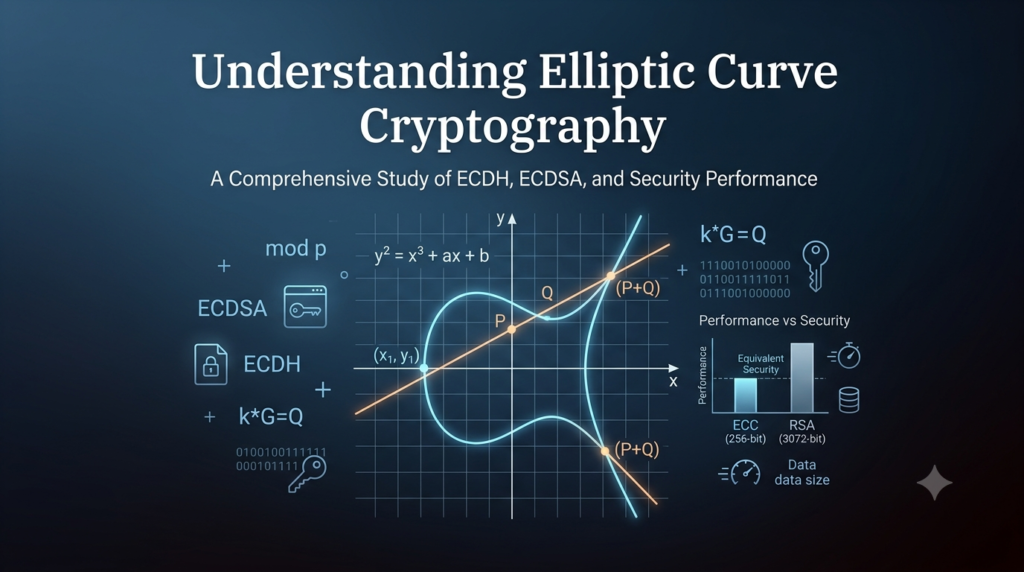
Dr. Dharmendra Saxena Professor, Department of Mathematics, University of Technology, Jaipur, Rajasthan, India Abstract Currently, the scale of digital communications is growing exponentially, and small networked devices with limited computing power are becoming increasingly widespread. To provide encryption protection for these devices, it is necessary to build an encryption system that can withstand attacks while not consuming excessive computational resources. Elliptic Curve Cryptography (ECC) has become the most mainstream solution today, as it can provide security protection equivalent to or even stronger than RSA with a much shorter key length. This study systematically constructs a complete mathematical foundation for ECC, disassembles its two core protocols — Elliptic Curve Diffie–Hellman and Elliptic Curve Digital Signature Algorithm, evaluates its ability to resist known attacks, and conducts performance benchmarking against the long-established RSA. We organize the algebraic geometric structure of elliptic curves over finite fields, derive the group law and scalar multiplication algorithm that support the operation of this set of algorithms, implement the full processes of ECDH and ECDSA, and complete empirical performance testing under multiple sets of standard key lengths. The test results show that under the premise of equivalent security levels, the speed of ECC key generation is approximately three times that of RSA, and the size of an ECDSA signature is only half that of an RSA signature with the same security level. A commonly used 256-bit ECC key has the same security protection capability as a 3072-bit RSA key; the currently optimal known classical attack method requires an estimated 2^128 operations to crack the underlying Elliptic Curve Discrete Logarithm Problem. ECC’s combination of efficiency and strong security makes it the preferred solution for modern secure communication systems, especially suitable for environments with limited bandwidth and computing power. Future research work needs to complete the transition to a post-quantum cryptography system through hybrid schemes to address potential long-term threats that may arise in the future. Keywords: Elliptic Curve Cryptography, Elliptic Curve Discrete Logarithm Problem, Elliptic Curve Diffie–Hellman, Elliptic Curve Digital Signature Algorithm, Public-Key Cryptography, Finite Fields, Secure Communication, Lightweight Cryptography Introduction 1.1 Background and Motivation The security of digital communications fundamentally relies on cryptographic systems. Such a system must enable encrypted data transmission, identity verification, and confirmation that transmitted content has not been tampered with, even on an untrusted network accessible to anyone. Otherwise, when transferring money from a mobile banking app, the transaction could be intercepted mid-transmission and the payee altered, making security impossible to guarantee. Early symmetric encryption algorithms required both communicating parties to pre-share the same set of keys — that is, a unified password to unlock encrypted content. This gave rise to the key distribution problem: how can two people who have never met safely negotiate a set of keys known only to each other? If the key were sent directly, it could be intercepted, rendering all subsequent encrypted communications useless. This problem puzzled cryptographers for many years. In 1976, Diffie and Hellman proposed public-key cryptography, which finally provided a breakthrough. They designed a set of mathematically linked public and private keys, with different keys used for encryption and decryption. Simply put, a public key can be freely disclosed: any content encrypted with the public key can only be decrypted by the matching private key. Eliminating the need to pre-transfer a shared key naturally solved the earlier distribution problem. In 1977, Rivest, Shamir, and Adleman introduced RSA, the first practical public-key system. Its security is based on the mathematical premise that large integer factorization is extremely difficult. However, as hardware performance continues to improve, key lengths that once could block ordinary computers from cracking codes have become increasingly insufficient to withstand new high-performance hardware. To maintain adequate security strength, RSA keys had to be made longer and longer, eventually requiring 3072-bit or even 7680-bit keys. Such a large computational load is unsustainable for small devices with limited computing power, such as smartphones and embedded devices. Even large-scale deployed server clusters, which process hundreds of thousands or millions of encryption requests daily, cannot bear such a heavy computational burden. Cryptographers urgently needed to find a more intractable mathematical problem — one that could achieve the same or higher security levels with shorter keys, upholding security bottom lines while reducing computational overhead. In 1985, Miller, and in 1987, Koblitz, independently proposed Elliptic Curve Cryptography, which perfectly addressed this demand. Its security foundation lies in the algebraic geometric properties of elliptic curves over finite fields. In modern network protocol design, ECC has largely replaced RSA and the classic Diffie–Hellman. This is not because its mathematics is simpler, but because its “hardness” aligns exactly with security requirements: the Elliptic Curve Discrete Logarithm Problem has a per-bit computational difficulty far exceeding that of large integer factorization. Even with much shorter keys, it can achieve the same security level as long-key RSA, perfectly solving the computational power problem encountered by RSA. When you open a banking website, your browser and the server complete a silent set of mathematical calculations in just a few milliseconds. Throughout the process, your password is never transmitted, and no private information is leaked, yet both parties end up calculating the same shared encryption key. This key is derived from the algebraic structure of points on an elliptic curve, with the finite fields used in these calculations invisible to the average person. The process leverages Elliptic Curve Cryptography — it is this set of mathematical logic that guards the security of the entire digital world. 1.2 Research Gap and Contribution While there is no shortage of existing reviews and tutorials discussing Elliptic Curve Cryptography, few integrate rigorous mathematical derivation, algorithm implementation, empirical benchmark testing, and security analysis into a unified study that meets current Scopus publication standards. Recent literature mostly focuses on ECC applications in specific fields such as cloud security, the Internet of Things, and blockchain. Most either fail to fully explain the mathematical logic that underpins the entire cryptographic system, or fail to provide implementable, reproducible implementation details that independent research teams can replicate,
