
Network Pharmacology-Guided Virtual Screening and Molecular Docking of Medicinal Plant Photochemical Against Key Therapeutic Targets of Type 2 Diabetes Mellitus
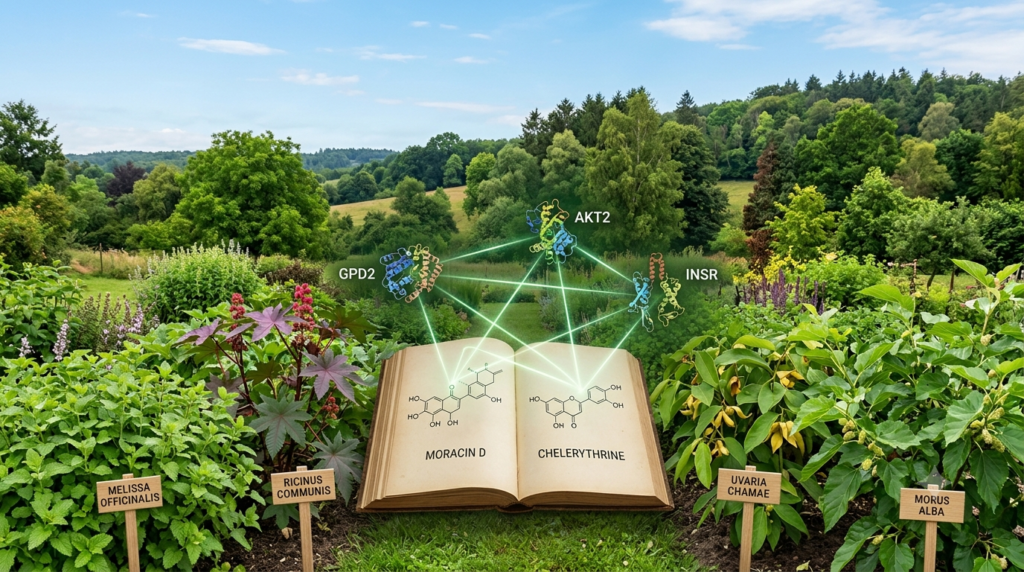
Dr. Suhas Rajaram Mache Professor, Department of Computer Science, University of Technology, Jaipur, Rajasthan, India Abstract Type 2 diabetes mellitus (T2DM) represents a global health crisis affecting over 537 million people worldwide, with projections indicating a rise to 783 million by 2045. Current synthetic antidiabetic therapies are associated with significant adverse effects, including gastrointestinal intolerance, hypoglycemia, cardiovascular risks, and weight gain, necessitating the exploration of safer, multi-targeted natural alternatives. This study employed an integrated network pharmacology approach combined with molecular docking, ADMET profiling, and molecular dynamics simulations to identify promising phytochemicals from medicinal plants targeting key T2DM-associated proteins. Fourteen therapeutic targets were selected, including PPARG, AKT2, INSR, AMPK, PTPN1, GCK, and SLC2A4. From an initial library of plant-derived compounds, 72 bioactive phytochemicals were shortlisted based on superior docking performance compared to reference drugs. Network analysis revealed multi-target compounds such as chelerythrine, emodin, rohitukine, and ursolic acid interacting with critical hub proteins. Molecular docking demonstrated that moracin D (−9.8 kcal/mol), chelerythrine (−10.4 kcal/mol), and plantagineoside A (−9.3 kcal/mol) exhibited stronger binding affinities than standard antidiabetic drugs. Molecular dynamics simulations over 500 ns confirmed the structural stability of top protein-ligand complexes, with RMSD values ranging from 4.39 Å to 5.33 Å. Pathway enrichment analysis highlighted involvement in insulin signaling, AMPK signaling, and adipocytokine pathways. These findings provide a computational foundation for developing plant-based multi-target therapeutics for T2DM management, though experimental validation remains essential. Keywords: network pharmacology, molecular docking, type 2 diabetes, phytochemicals, medicinal plants, virtual screening Introduction Type 2 diabetes mellitus (T2DM) is a chronic metabolic disorder characterized by insulin resistance, impaired insulin secretion, and persistent hyperglycemia, leading to severe microvascular and macrovascular complications including nephropathy, retinopathy, neuropathy, and cardiovascular disease (Ononamadu et al., 2025). The global prevalence of diabetes has reached epidemic proportions, with approximately 529 million people affected in 2021, of which T2DM accounts for more than 80% of cases (Maulana et al., 2026). The International Diabetes Federation projects this number will escalate to 643 million by 2030 and 783 million by 2045, disproportionately affecting middle- and low-income countries (Ononamadu et al., 2025). Despite advances in pharmacotherapy, current antidiabetic medications are associated with considerable limitations. Metformin, the first-line therapy, frequently causes gastrointestinal intolerance and, rarely, lactic acidosis (Nature, 2025). Sulfonylureas induce hypoglycemia and weight gain, while thiazolidinediones are linked to cardiovascular risks, edema, and bone fractures (Nature, 2025). These adverse effects, coupled with the inability of existing therapies to halt disease progression completely, underscore the urgent need for safer, multi-targeted therapeutic alternatives (Maulana et al., 2026). Medicinal plants and their phytochemical constituents have garnered substantial attention as potential sources of novel antidiabetic agents due to their multi-component, multi-target mechanisms of action and favorable safety profiles (Ononamadu et al., 2025). Traditional medicine systems worldwide have employed plants such as Melissa officinalis, Ricinus communis, Uvaria chamae, and numerous Indian medicinal herbs for diabetes management, with growing scientific evidence supporting their hypoglycemic and insulin-sensitizing properties (Ononamadu et al., 2025; Maulana et al., 2026). The complexity of T2DM pathophysiology, involving multiple interconnected pathways such as insulin signaling, glucose metabolism, inflammation, and lipid homeostasis, necessitates a systems-level approach to drug discovery (Nature, 2025). Network pharmacology, which integrates network biology, polypharmacology, and systems biology, offers a powerful framework for elucidating the multi-target mechanisms of phytochemicals in complex diseases like diabetes (Ononamadu et al., 2025). This approach, combined with structure-based computational methods such as molecular docking, virtual screening, ADMET prediction, and molecular dynamics (MD) simulations, enables the efficient identification and prioritization of promising lead compounds from vast natural product libraries (Maulana et al., 2026). Recent studies have successfully applied network pharmacology and molecular docking to investigate antidiabetic mechanisms of medicinal plants. For instance, Ononamadu et al. (2025) identified isoquercitrin from M. officinalis as a multi-target compound with strong binding to EGFR, PPARα, and AKT1, while a comprehensive study screening 72 natural compounds against 14 T2DM targets revealed moracin D, chelerythrine, and ursolic acid as promising candidates with superior binding affinities compared to reference drugs (Nature, 2025). Similarly, investigations on Ricinus communis identified seven bioactive compounds—quercetin, apigenin, kaempferol, stigmasterol, β-sitosterol, ellagic acid, and epicatechin—with strong docking scores against hub targets involved in diabetes and inflammation (PubMed, 2025). This study aims to comprehensively review and synthesize current evidence on network pharmacology-guided virtual screening and molecular docking of medicinal plant phytochemicals against key therapeutic targets of T2DM. Specifically, we (a) identify critical T2DM-associated protein targets amenable to phytochemical modulation, (b) evaluate the binding affinities and interaction patterns of plant-derived compounds compared to standard antidiabetic drugs, (c) analyze compound-target-pathway networks to reveal multi-target mechanisms, and (d) assess the pharmacokinetic viability and structural stability of top-ranked phytochemicals through ADMET profiling and MD simulations. This integrative approach provides a computational foundation for developing plant-based, multi-target therapeutics for T2DM management. Materials and Methods Target Selection and Data Collection Therapeutic targets associated with T2DM were identified through comprehensive searches of the Online Mendelian Inheritance in Man (OMIM) database, STRING v.12.0, GeneCards, Therapeutic Target Database (TTD), DisGeNET, KEGG, and Malacards (Nature, 2025; Ononamadu et al., 2025). Search terms included “Type 2 Diabetes,” “Diabetes Mellitus,” “insulin resistance,” and “hyperglycemia.” From an initial list of 30 OMIM entries and 122 STRING-identified targets, 14 proteins were selected based on their established roles in T2DM pathophysiology and availability of three-dimensional crystallographic structures in the RCSB Protein Data Bank (PDB) (Nature, 2025). Selected targets included: glycerol-3-phosphate dehydrogenase 2 (GPD2), insulin receptor substrate 1 (IRS1), peroxisome proliferator-activated receptor gamma (PPARG), islet amyloid polypeptide (IAPP), glucokinase (GCK), ATP-binding cassette subfamily C member 8 (ABCC8), mitogen-activated protein kinase 8 (MAPK8), melatonin receptor 1B (MTNR1B), AKT serine/threonine kinase 2 (AKT2), protein tyrosine phosphatase non-receptor type 1 (PTPN1), insulin receptor (INSR), AMP-activated protein kinase (AMPK/PRKAG3), alpha-glucosidase (GAA), and glucose transporter type 4 (SLC2A4) (Nature, 2025). Three-dimensional X-ray crystallographic structures of these proteins were retrieved from the RCSB PDB (http://www.pdb.org), with PDB IDs documented for each target (Nature, 2025). Phytochemical Library Curation Natural compounds targeting the 14 T2DM-associated proteins were retrieved from the Natural Product Activity and Species Source Database (NPASS) and the ZINC12 database (Nature,
